Effective Discipline for 2-Year-Olds: Reduce Tantrums by 40% in 3 Months

Implementing consistent, gentle discipline strategies can significantly reduce tantrums in 2-year-olds, fostering a more harmonious home environment and promoting healthy child development through practical, step-by-step approaches.
Navigating the toddler years can feel like a rollercoaster, especially when dealing with the unpredictable emotional outbursts commonly known as tantrums. For parents seeking to implement effective toddler discipline, understanding the developmental stage of a 2-year-old is the first crucial step towards a calmer household. This guide offers a step-by-step approach designed to help reduce tantrums by a significant margin, aiming for up to 40% reduction within a three-month period, by providing practical, actionable solutions.
Understanding the 2-Year-Old Mindset: Why Tantrums Happen
Two-year-olds are a bundle of rapidly developing emotions and limited communication skills. Their world is expanding, but their ability to express complex feelings like frustration, anger, or sadness often lags behind their experiences. This developmental mismatch is a primary driver of tantrums, which are essentially their way of communicating when words fail them.
The developing brain and emotional regulation
At two years old, a child’s prefrontal cortex, responsible for impulse control and emotional regulation, is still very much in its infancy. This means they genuinely struggle to manage strong feelings. Expecting a toddler to calmly articulate their needs or control their impulses in the heat of the moment is often unrealistic, leading to further frustration for both parent and child.
- Limited vocabulary: Inability to articulate desires or discomforts.
- Developing independence: Frustration when unable to perform tasks independently.
- Overtired or overstimulated: Essential needs not met can trigger meltdowns.
- Seeking attention: Sometimes a tantrum is a cry for connection.
Recognizing these underlying causes helps parents approach tantrums with empathy rather than immediate frustration. It’s not about being ‘naughty’; it’s about being overwhelmed. Understanding this shifts the disciplinary approach from punitive to supportive, aiming to teach coping mechanisms rather than just stopping the behavior.
Ultimately, tantrums are a normal part of toddler development. By understanding the root causes and developmental limitations, parents can better equip themselves with strategies that address the child’s needs while guiding them towards more appropriate forms of expression. This foundational understanding sets the stage for more effective disciplinary techniques.
Establishing Clear Boundaries and Consistent Routines
One of the most powerful tools in effective discipline for 2-year-olds is the establishment of clear, consistent boundaries and predictable routines. Toddlers thrive on predictability, as it provides a sense of security and control in a world that often feels overwhelming. When they know what to expect, they are less likely to resist and more likely to cooperate.
Start by identifying a few key areas where boundaries are essential for safety and well-being, such as screen time, mealtime behavior, or bedtime routines. Keep these rules simple and few, as too many rules can be confusing for a toddler. Communicate them clearly and consistently, using simple language your child can understand.
The power of predictability
A consistent daily schedule helps toddlers anticipate what comes next, reducing anxiety and the likelihood of unexpected meltdowns. For example, if snack time always follows playtime, your child learns to expect this sequence. Deviations from routine should be explained simply beforehand, if possible, to minimize surprises.
- Set consistent bedtimes and wake-up times.
- Follow a predictable meal and snack schedule.
- Establish clear expectations for playtime and clean-up.
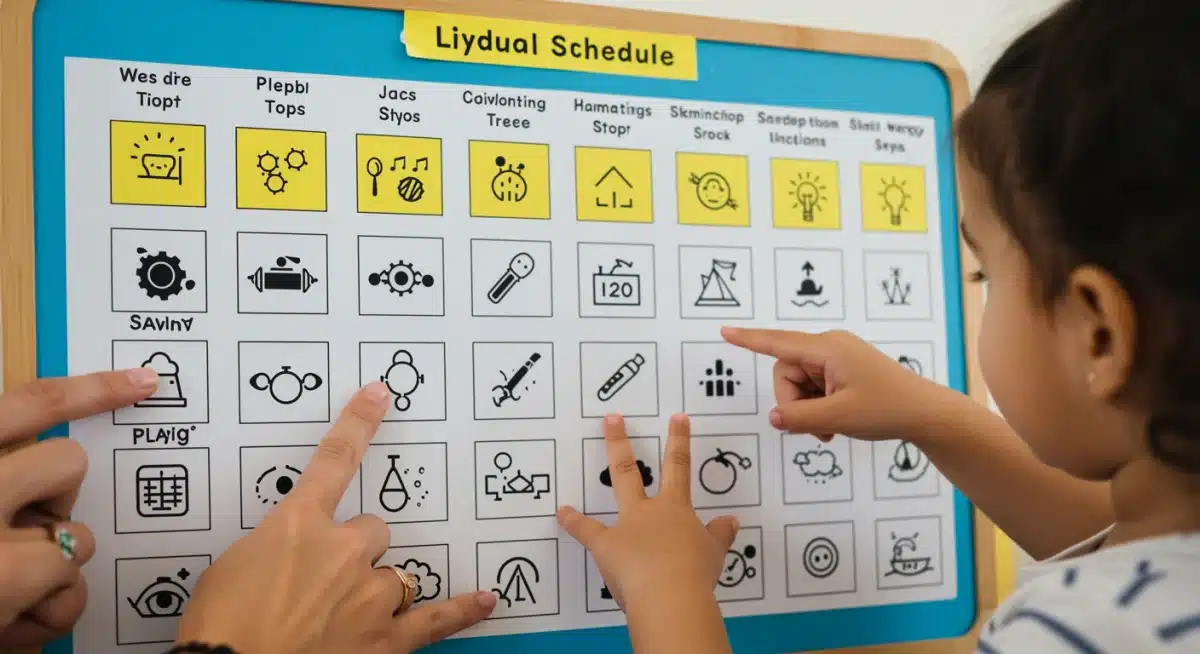
- Use visual schedules to help your child understand the day’s events.
Consistency is paramount. If a boundary is set, it must be enforced every time. Inconsistency can confuse a child and inadvertently teach them that rules are flexible, leading to more testing of boundaries. While it can be exhausting, maintaining consistency pays off in the long run by fostering a sense of order and security for your child.
By creating a structured yet flexible environment, parents provide the framework within which a 2-year-old can learn self-control and cooperation. This proactive approach not only reduces tantrums but also lays the groundwork for future behavioral success.
Positive Reinforcement and Effective Communication
Positive reinforcement is a cornerstone of effective toddler discipline. Instead of focusing solely on what your child is doing wrong, actively acknowledge and praise their positive behaviors. This encourages them to repeat desirable actions and builds their self-esteem, making them more receptive to guidance.
When you see your 2-year-old sharing a toy, helping to clean up, or using their words instead of whining, offer specific praise. For example, instead of just saying “Good job,” try “I love how you shared your blocks with your sister!” This helps them understand exactly what behavior is being acknowledged.
Communicating effectively with a toddler
Toddlers are still developing their language skills, so effective communication requires patience and simplicity. Use short, clear sentences. Get down to their eye level to ensure you have their attention. Instead of asking open-ended questions that might overwhelm them, offer choices.
- Use simple, direct language.
- Offer limited choices (e.g., “Do you want the red cup or the blue cup?”).
- Describe feelings: “I see you’re feeling angry because you can’t have another cookie right now.”
- Model desired behavior: Show them how to ask for things politely.
Active listening is also vital. Even if their words are unclear, try to understand the emotion behind their communication. Acknowledging their feelings, even if you can’t fulfill their request, can diffuse a situation. “I understand you really want that toy, but it’s not safe to play with right now.” This validates their emotions while still maintaining boundaries.
By focusing on positive reinforcement and clear, empathetic communication, parents can build a strong, trusting relationship with their toddler. This foundation makes disciplinary moments less confrontational and more about teaching and learning.
Implementing Gentle Time-Outs and Logical Consequences
While positive reinforcement and clear boundaries are crucial, there will inevitably be times when a 2-year-old’s behavior requires a more direct consequence. Gentle time-outs and logical consequences are effective tools in effective toddler discipline, teaching children about boundaries and the natural outcomes of their actions without resorting to harsh punishment.
A time-out for a 2-year-old is not about punishment, but about providing a brief period for them to calm down and regain control. The general rule of thumb is one minute per year of age, so a 2-year-old’s time-out should typically be two minutes. Choose a designated ‘calm-down’ spot that is safe and free from distractions, but not scary.
How to use time-outs effectively
When a behavior warrants a time-out (e.g., hitting, biting, or intentionally breaking a rule), calmly explain what they did wrong and why they are going to the calm-down spot. For example, “We don’t hit. Because you hit, you need to sit in your chair for two minutes to calm down.”
- Choose a neutral, safe time-out spot.
- Keep it brief: 1 minute per year of age.
- Explain the reason simply and calmly.
- Stay consistent and follow through every time.
Logical consequences are directly related to the child’s misbehavior. If a child throws their food, the logical consequence is that mealtime is over. If they refuse to put away toys, the toys are put away by the parent for a short period. These consequences teach cause and effect in a way that is understandable to a toddler.
The key to both time-outs and logical consequences is to remain calm and consistent. Yelling or showing anger can escalate the situation. The goal is to teach, not to shame. After the time-out or consequence, reconnect with your child, reminding them of the expected behavior and offering comfort.
By using these gentle yet firm methods, parents can guide their 2-year-olds toward understanding appropriate behavior and developing self-regulation skills, reducing the frequency and intensity of future tantrums.
Managing Tantrums in the Moment: De-escalation Techniques
Despite all preventative measures, tantrums will still occur. The ability to effectively manage a tantrum in the moment is a critical skill for parents. The goal is not to ‘win’ the tantrum, but to help your child regain control and teach them healthier ways to cope with big emotions. This involves a combination of patience, empathy, and strategic responses.
Firstly, try to identify the underlying cause of the tantrum. Is your child tired, hungry, overstimulated, or frustrated? Addressing the root cause can sometimes de-escalate the situation quickly. If they are overstimulated, move to a quieter environment. If hungry, offer a healthy snack.
Practical de-escalation strategies
When a tantrum is in full swing, it’s often unproductive to reason or lecture. Your child’s emotional brain has taken over. Focus on safety and calm. Get down to their level, make eye contact if possible, and use a calm, reassuring voice.
- Stay calm yourself: Your calm demeanor can be contagious.
- Acknowledge their feelings: “I see you’re really mad right now.”
- Offer comfort: A hug or gentle touch can sometimes help, if accepted.
- Redirect attention: Offer a different activity or object of interest.
- Ignore minor tantrums: For attention-seeking tantrums, sometimes ignoring the behavior (while ensuring safety) can be effective.
Avoid giving in to demands made during a tantrum, as this reinforces the idea that tantrums are an effective way to get what they want. Once the tantrum has subsided, and your child is calm, you can briefly discuss what happened and reiterate expectations. This post-tantrum conversation should be short and focused on teaching, not shaming.
Effectively managing tantrums in the moment requires a blend of empathy, firm boundaries, and a calm presence. By consistently applying these de-escalation techniques, parents can help their 2-year-olds navigate challenging emotions and learn valuable coping skills, diminishing the power and frequency of future outbursts.
Long-Term Strategies for Emotional Regulation and Independence
Beyond immediate tantrum management, fostering emotional regulation and a healthy sense of independence in your 2-year-old are crucial long-term goals for effective toddler discipline. These strategies equip children with the inner resources to handle frustrations and make good choices as they grow, contributing to a significant reduction in challenging behaviors over time.
Encourage emotional literacy by helping your child identify and name their feelings. Use picture books that depict various emotions, and talk about characters’ feelings. When your child expresses an emotion, help them put a word to it: “You look frustrated that the tower fell down.” This builds their emotional vocabulary and understanding.
Building independence and problem-solving skills
Allowing your child to make age-appropriate choices and solve simple problems fosters independence and competence. Instead of doing everything for them, offer opportunities for them to contribute and succeed. This could be choosing their outfit, helping to set the table, or deciding which toy to play with first.
- Teach emotion words: Use books and daily conversations to label feelings.
- Practice problem-solving: Guide them to find solutions for small challenges.
- Encourage self-help skills: Let them dress themselves or pour their water (with supervision).
- Provide opportunities for imaginative play: This helps them process emotions and practice social skills.
Praise their effort and perseverance, not just the outcome. This teaches them resilience and the value of trying, even when things are difficult. When they encounter a challenge, instead of immediately stepping in, ask, “What can you try next?” or “How do you think we can fix this?”
Cultivating emotional intelligence and independence takes time and consistent effort. However, by investing in these long-term strategies, parents empower their 2-year-olds to become more self-aware, resilient, and capable individuals, ultimately leading to fewer tantrums and a more confident, well-adjusted child.
| Key Strategy | Brief Description |
|---|---|
| Understand Toddler Development | Recognize limited communication and emotional regulation as tantrum drivers. |
| Establish Routines & Boundaries | Provide security and predictability with clear, consistent rules. |
| Positive Reinforcement | Praise desired behaviors to encourage recurrence and build self-esteem. |
| Gentle Time-Outs & Consequences | Teach boundaries and cause-effect calmly, without shaming. |
Frequently asked questions about toddler discipline
While every child is different, consistent application of new discipline strategies typically shows noticeable improvements within 2-4 weeks. Significant reductions in tantrum frequency, aiming for 40% or more, can often be observed within three months as the child adapts to the new routines and expectations.
Ignoring a tantrum can be effective for attention-seeking behaviors, but it’s not always appropriate. For tantrums stemming from frustration, hunger, or overtiredness, a calm, empathetic response or addressing the underlying need is more beneficial. Always ensure your child’s safety if you choose to ignore.
If your child bites or hits, immediately intervene by calmly but firmly removing them from the situation or the person they are harming. State clearly, “No hitting/biting, that hurts.” Then, implement a brief, consistent time-out or a logical consequence, ensuring they understand the behavior is unacceptable.
Observing patterns can help. Genuine needs often escalate quickly and are hard to soothe without addressing the core issue (e.g., hunger). Tantrums, especially for attention, might subside if ignored or redirected. Learn your child’s cues; a sudden, inconsolable cry might signal a true need.
Time-outs can be effective for many 2-year-olds when used consistently and calmly, focusing on providing a space to regain control rather than punishment. However, some children may respond better to redirection or connection-based strategies. It’s important to adapt techniques to your child’s individual temperament and needs.
Conclusion
Implementing effective toddler discipline for 2-year-olds is a journey that demands patience, consistency, and a deep understanding of child development. By establishing clear boundaries, maintaining predictable routines, and consistently employing positive reinforcement, parents can proactively reduce the frequency and intensity of tantrums. When outbursts do occur, utilizing gentle time-outs, logical consequences, and empathetic de-escalation techniques can guide children toward better emotional regulation. Focusing on long-term strategies that foster emotional literacy and independence will empower your child, ultimately leading to fewer tantrums and a more harmonious family life. This comprehensive approach not only aims to reduce tantrums by 40% in three months but also builds a strong foundation for your child’s emotional growth and well-being.