Boosting Child’s Social-Emotional Development: 5 Data-Backed Strategies

Parents can effectively boost their child’s social-emotional development by implementing five data-backed strategies focused on fostering emotional regulation, empathy, and strong communication skills for a resilient future.
In today’s rapidly evolving world, focusing on child social-emotional development is more crucial than ever. As parents, we strive to equip our children with the tools needed to navigate life’s complexities, build meaningful relationships, and understand their own feelings.
This article delves into five data-backed strategies, offering insider knowledge and practical solutions to foster these vital skills in your child by 2026.
Understanding social-emotional development
Social-emotional development encompasses a child’s ability to understand and manage emotions, set and achieve positive goals, feel and show empathy for others, establish and maintain positive relationships, and make responsible decisions.
It’s the foundation upon which all other learning and life skills are built. Research consistently highlights its predictive power for academic success, career achievements, and overall well-being.
The pillars of healthy development
Healthy social-emotional development rests on several key pillars, each contributing to a child’s holistic growth. These pillars are interconnected, meaning progress in one area often supports development in others.
- Self-awareness: Recognizing one’s own emotions, strengths, and weaknesses.
- Self-management: Regulating emotions, thoughts, and behaviors effectively in different situations.
- Social awareness: Understanding the perspectives of others and empathizing with them.
- Relationship skills: Building and maintaining healthy relationships, cooperating, and resolving conflicts constructively.
- Responsible decision-making: Making ethical, constructive choices about personal and social behavior.
These pillars are not innate; they are learned and honed through consistent practice and supportive environments. Parents play the most significant role in cultivating these skills, acting as primary guides and role models.
By understanding these foundational elements, we can more effectively target our efforts to boost our children’s social-emotional capabilities.
Strategy 1: fostering emotional literacy and regulation
Emotional literacy is the ability to identify, understand, and respond to emotions in oneself and others. It’s the bedrock of emotional intelligence and a vital component of social-emotional development.
Teaching children to name their feelings and understand why they feel a certain way empowers them to manage those emotions constructively.
Teaching emotion vocabulary
Start by actively teaching your child a wide range of emotion words beyond just “happy,” “sad,” and “mad.” Use books, facial expressions, and real-life situations to illustrate different feelings.
When a child expresses an emotion, help them label it. For instance, “It looks like you’re feeling frustrated because your tower fell down.”
- Read books about feelings and discuss characters’ emotions.
- Use emotion cards or charts to help identify feelings.
- Validate their feelings, even if the behavior isn’t acceptable.
Once children can identify emotions, the next step is teaching regulation. This doesn’t mean suppressing feelings, but rather finding healthy ways to cope with them. Techniques like deep breathing, counting, or taking a break can be incredibly effective.
Model these behaviors yourself; children learn best by observing.
Strategy 2: encouraging empathy and perspective-taking
Empathy, the ability to understand and share the feelings of another, is a cornerstone of positive social interactions and a crucial aspect of child social-emotional development.
It allows children to connect with others, build strong friendships, and act with kindness. Cultivating empathy requires intentional effort from parents.
Conversations about others’ feelings
Engage your child in discussions about how others might be feeling in various situations. This could be when watching a movie, reading a story, or observing people in public.
Ask questions like, “How do you think that character feels right now? Why do you think they feel that way?”
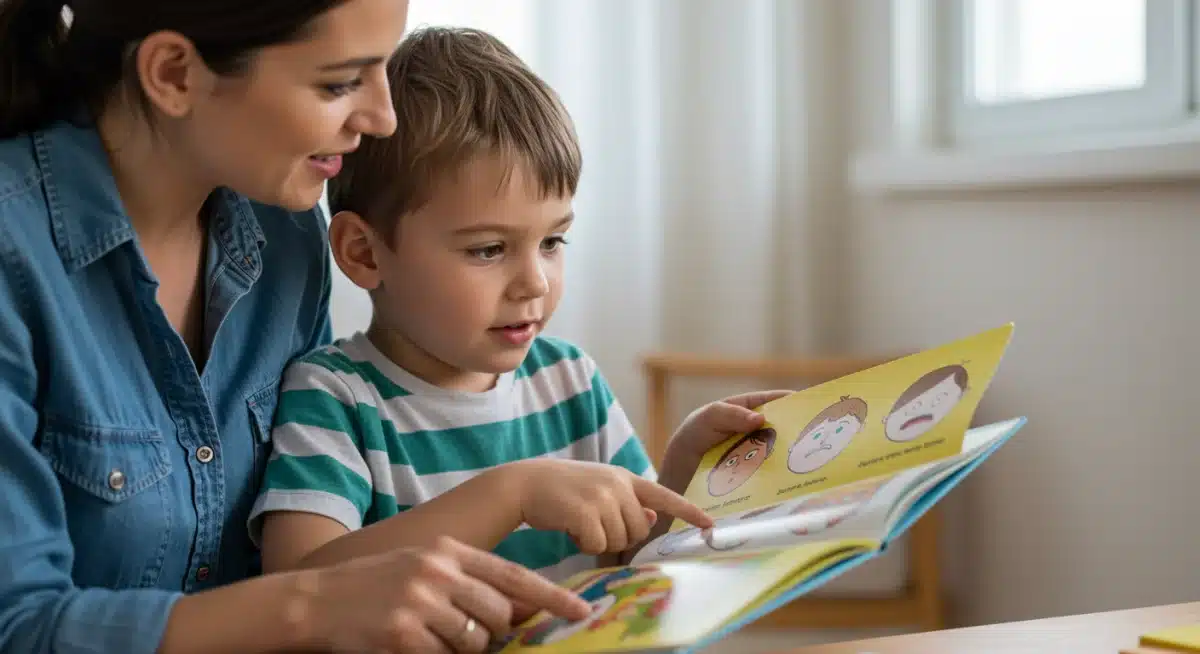
Encourage your child to consider different perspectives, even if they don’t agree with them. This helps them move beyond their own immediate desires and understand the complexities of social dynamics.
It’s about fostering a sense of curiosity about others’ inner worlds.
Strategy 3: promoting positive communication and conflict resolution
Effective communication is fundamental for all social interactions. Teaching children how to express their needs and feelings clearly, and how to listen actively to others, prevents misunderstandings and builds stronger bonds.
Conflict is inevitable, but how children learn to resolve it makes all the difference.
Active listening and clear expression
Model active listening by giving your child your full attention when they speak, making eye contact, and reflecting on what they’ve said. Teach them to do the same when others are talking.
Help them articulate their thoughts and feelings using “I” statements, such as, “I feel sad when you take my toy without asking.”
- Practice role-playing difficult conversations.
- Encourage them to pause and think before reacting.
- Teach them the importance of politeness and respect in dialogue.
When conflicts arise, guide your child through a resolution process rather than solving it for them. This involves identifying the problem, brainstorming solutions, and choosing one that works for everyone.
This approach empowers them to become independent problem-solvers and fosters a sense of fairness.
Strategy 4: building resilience and self-esteem
Resilience is the capacity to recover quickly from difficulties; toughness. It’s a critical aspect of child social-emotional development that allows children to face challenges, learn from setbacks, and adapt to change.
Self-esteem, a child’s overall sense of self-worth, is closely linked to resilience and foundational for mental health.
Embracing challenges and learning from mistakes
Instead of shielding children from every difficulty, allow them to experience and overcome age-appropriate challenges. This builds their confidence in their own abilities.
When mistakes happen, frame them as learning opportunities rather than failures. Discuss what went wrong and what could be done differently next time.
- Praise effort and perseverance, not just outcomes.
- Encourage participation in activities that challenge them positively.
- Help them set realistic, achievable goals.
Foster a growth mindset, where children understand that their abilities can be developed through dedication and hard work. This contrasts with a fixed mindset, where talents are seen as static.
A growth mindset is a powerful tool for building resilience and robust self-esteem.
Strategy 5: creating a supportive and predictable environment
A child’s environment plays a monumental role in their social-emotional development. A home that is safe, predictable, and emotionally responsive provides the ideal conditions for children to thrive.
Consistency in routines and expectations creates a sense of security, allowing children to explore and learn without undue anxiety.
The power of routines and clear expectations
Establishing consistent daily routines helps children feel secure and understand what to expect. This predictability reduces stress and allows them to focus their energy on learning and developing.
Clear, age-appropriate expectations for behavior, coupled with consistent consequences, teach children self-discipline and responsibility.
- Maintain a consistent daily schedule, especially for sleep and meals.
- Communicate rules clearly and ensure they are understood.
- Provide a balance of structure and opportunities for free play.
Beyond routines, creating an emotionally supportive atmosphere means actively listening to your child, validating their feelings, and offering comfort and reassurance.
When children feel loved and understood, they are more likely to develop secure attachments and strong social-emotional skills.
| Key Strategy | Brief Description |
|---|---|
| Emotional Literacy | Teach children to identify, understand, and healthily manage their emotions. |
| Empathy & Perspective | Encourage understanding and sharing of others’ feelings and viewpoints. |
| Positive Communication | Develop clear expression and effective conflict resolution skills. |
| Resilience Building | Foster the ability to bounce back from challenges and grow from mistakes. |
Frequently asked questions about social-emotional development
Social-emotional development refers to a child’s ability to understand and manage emotions, build relationships, and make responsible decisions. It’s crucial because it predicts academic success, mental health, and overall life satisfaction, laying the foundation for future well-being.
Encourage emotional expression by teaching emotion vocabulary, validating their feelings, and modeling healthy emotional responses. Use books and real-life scenarios to discuss different feelings, offering a safe space for them to share without judgment.
Practical ways include discussing how others might feel in various situations (e.g., characters in stories), encouraging acts of kindness, and prompting them to consider different perspectives. Role-playing and community involvement can also foster empathetic understanding.
Routines provide predictability and a sense of security, reducing anxiety and stress for children. This stable environment allows them to feel safe, explore, and focus on developing their social and emotional skills more effectively, fostering independence and confidence.
Yes, social-emotional skills can be continually developed and refined throughout a person’s life, not just in childhood. While early intervention is highly beneficial, consistent practice and supportive environments can lead to significant improvements at any age.
Conclusion
Boosting your child’s social-emotional development is an ongoing journey that yields profound rewards. By consistently applying these five data-backed strategies—fostering emotional literacy, encouraging empathy, promoting positive communication, building resilience, and creating a supportive environment—parents can empower their children with the essential skills needed to thrive in 2026 and beyond.
These efforts not only enhance their immediate well-being but also lay a strong foundation for a future filled with meaningful connections, personal fulfillment, and success.