Boost Family Communication: 4 Game Nights for 25% More Engagement
In the bustling world of 2026, where digital distractions often pull us in different directions, the cornerstone of a strong family unit remains effective communication. It’s not just about talking; it’s about truly connecting, understanding, and growing together. But how do we achieve this in an increasingly fast-paced environment? The answer might be simpler, and a lot more fun, than you think: through interactive family game nights. Studies suggest that structured play can increase family engagement and communication by as much as 25%, fostering an environment where everyone feels heard, valued, and connected. This article will delve into four specific game nights that are proven to boost family communication games and strengthen your family’s bond.
The importance of robust family communication cannot be overstated. It lays the foundation for trust, reduces conflict, and helps children develop crucial social and emotional skills. When communication thrives, families navigate challenges more effectively, celebrate successes more heartily, and create a reservoir of shared memories that last a lifetime. Yet, for many families, finding dedicated time and engaging methods to foster this communication can be a significant hurdle. This is where the magic of family game nights comes in, transforming ordinary evenings into extraordinary opportunities for connection and dialogue.
We’re not just talking about any games; we’re focusing on interactive experiences designed to spark conversation, encourage empathy, and promote collaborative problem-solving. These aren’t just time-fillers; they are strategic tools for building a more cohesive and communicative family. By integrating these specific family communication games into your routine, you’re not just playing; you’re investing in the emotional health and well-being of your family unit. Let’s explore how these game nights can revolutionize your family dynamics and bring you closer together than ever before.
The Power of Play: Why Game Nights Enhance Family Communication
Before we dive into the specific games, let’s understand the profound psychological and social benefits that make game nights such effective tools for improving family communication. When families engage in play, several powerful mechanisms are activated, all contributing to stronger bonds and better dialogue.
Breaking Down Barriers
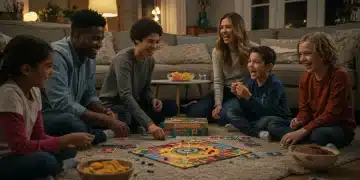
One of the primary benefits of family game nights is their ability to break down communication barriers. In our daily lives, formal conversations can sometimes feel forced or intimidating, especially for children who might be hesitant to share their thoughts or feelings. Games, however, create a relaxed and low-stakes environment where everyone feels more comfortable expressing themselves. The focus shifts from ‘serious talk’ to ‘fun interaction,’ naturally opening up channels for more authentic and spontaneous communication. This informal setting allows family members to see each other in new lights, fostering empathy and understanding.
Encouraging Active Listening
Many interactive games inherently require active listening. Whether it’s understanding complex rules, deciphering clues, or responding to another player’s move, participants must pay close attention to what others are saying and doing. This practiced skill translates directly into improved everyday communication. When family members are accustomed to listening carefully during games, they are more likely to apply this attentiveness to serious conversations, leading to fewer misunderstandings and more meaningful exchanges. These family communication games naturally cultivate an environment of mutual respect for each other’s contributions.
Promoting Problem-Solving and Collaboration
A significant number of effective family communication games involve collaborative problem-solving. Families work together towards a common goal, strategizing, negotiating, and making decisions as a team. This collaborative effort strengthens communication by requiring clear articulation of ideas, constructive feedback, and compromise. Children learn to voice their opinions respectfully, and parents learn to value their children’s insights, creating a more egalitarian communication dynamic. This shared experience of overcoming challenges together builds a sense of unity and shared purpose.
Creating Shared Experiences and Memories
Perhaps one of the most enduring benefits of family game nights is the creation of shared experiences and lasting memories. These moments of joy, laughter, and sometimes even playful frustration become the fabric of your family’s story. Recalling a hilarious moment from a game or a clever strategy that led to victory provides common ground for future conversations and reinforces the positive emotional connections within the family. These shared narratives are vital for building a strong family identity and a sense of belonging for every member. This is particularly crucial for boosting family communication games as it provides a rich context for ongoing dialogue.
Reducing Screen Time and Enhancing Presence
In an era dominated by screens, dedicated game nights offer a vital antidote. They encourage families to put away their phones, turn off the TV, and be fully present with one another. This undivided attention is a rare commodity in modern life and is absolutely essential for fostering deep and meaningful communication. When everyone is focused on the same activity, free from digital distractions, the quality of interaction dramatically improves. The simple act of being together, fully engaged, is a powerful statement of love and commitment to family connection.
By understanding these underlying principles, we can better appreciate why the following family communication games are so effective. They are not just about entertainment; they are carefully chosen activities designed to tap into these powerful benefits, ultimately leading to a 25% increase in family engagement and communication by 2026.
Game Night 1: ‘Story Weavers’ – Unleashing Creativity and Empathy
Our first recommended game night focuses on narrative, creativity, and understanding different perspectives. ‘Story Weavers’ isn’t a single commercial game but a concept that can be adapted with various tools, designed to encourage imaginative expression and active listening, making it a stellar choice for family communication games.
How it Works:
The core idea is collaborative storytelling. You can use story cubes (dice with various images on their faces), a deck of picture cards (like Dixit or Rory’s Story Cubes), or even just a random object as a prompt. One person starts a story with a sentence or two, incorporating the prompt. The next person adds to the story, building upon what the previous person said, and so on. The goal isn’t to create a perfect narrative but to listen carefully, build on others’ ideas, and let the story unfold organically.
Variations for Different Ages:
- Younger Children: Keep sentences short and focus on simple cause-and-effect. Encourage silly ideas and don’t worry about plot consistency.
- Older Children/Teens: Introduce challenges like incorporating a specific emotion, a plot twist, or a moral dilemma into their part of the story. You can also assign roles (e.g., ‘You are the hero,’ ‘You are the villain’) to encourage different perspectives.
- Advanced Play: Introduce a ‘theme’ for the night (e.g., a space adventure, a mystery, a magical forest) to provide some structure.
Communication Boosters:
- Active Listening: To contribute meaningfully, each family member must actively listen to the preceding parts of the story, understanding the plot, characters, and tone. This directly enhances their ability to listen in everyday conversations.
- Empathy Development: As characters and situations develop, participants naturally put themselves in the shoes of fictional beings, which can translate into greater empathy for real-life family members.
- Creative Expression: This game provides a safe space for everyone to express their creativity without judgment. Hearing different family members’ imaginative contributions can reveal new facets of their personalities.
- Turn-Taking and Respect: The structured turn-taking reinforces the importance of allowing everyone a chance to speak and be heard, a fundamental aspect of healthy family communication.
The beauty of ‘Story Weavers’ is its flexibility and the sheer joy of creating something together. It’s a powerful tool among family communication games for fostering imagination and deeply connected dialogue.
Game Night 2: ‘Would You Rather?’ – Deepening Understanding and Values
‘Would You Rather?’ is a classic for a reason. It’s simple, engaging, and incredibly effective at sparking conversation, revealing preferences, and understanding the values that drive each family member. This makes it an invaluable addition to your repertoire of family communication games.
How it Works:
One person poses a question offering two equally appealing or equally unappealing choices (e.g., ‘Would you rather have the ability to fly or be invisible?’). Everyone then answers, and crucially, explains their reasoning. The ‘why’ is far more important than the ‘what.’ This explanation leads to fascinating discussions and insights into each other’s thought processes.
Creating Engaging Questions:
- Funny/Silly: ‘Would you rather have a pet dragon or a pet unicorn?’
- Thought-Provoking: ‘Would you rather know the date of your death or the cause of your death?’
- Ethical Dilemmas: ‘Would you rather save five strangers or one family member?’ (Use with caution and sensitivity, especially with younger children).
- Personal Preferences: ‘Would you rather live in a house by the beach or a cabin in the mountains?’
Communication Boosters:
- Uncovering Values: The reasons behind choices often reveal deeply held values, priorities, and fears. This can lead to profound insights into what truly matters to each family member.
- Practicing Articulation: Explaining complex reasoning in a clear and concise way is a vital communication skill, which this game naturally cultivates.
- Perspective-Taking: Hearing why someone chose differently from you encourages perspective-taking and an understanding that there are valid reasons behind various viewpoints.
- Non-Judgmental Sharing: The lighthearted nature of the game makes it safe for everyone to share their thoughts without fear of judgment, fostering an open and accepting communication environment.
- Building Connection: Shared laughter and surprising revelations build intimacy and connection, reinforcing the emotional bonds within the family.
Prepare a list of questions beforehand or use readily available card sets. The beauty of ‘Would You Rather?’ as one of the quintessential family communication games is its simplicity and the depth of conversation it can unlock with minimal effort.
Game Night 3: ‘Family Project Challenge’ – Collaborative Problem-Solving
Sometimes the best way to communicate is by doing, and the ‘Family Project Challenge’ is all about collaborative problem-solving. This isn’t a board game, but an activity-based game night designed to foster teamwork, negotiation, and shared accomplishment, making it a unique entry among family communication games.
How it Works:
Choose a project that requires multiple steps and different skills. The key is that everyone must contribute. Examples include building a complex LEGO set, assembling a large jigsaw puzzle, cooking a new recipe together from scratch, or even planning and executing a small home improvement task (like planting a mini herb garden or organizing a specific cupboard). The challenge lies in the process of working together, not just the finished product.
Project Ideas:
- Creative Builds: LEGO Technic sets, intricate K’nex models, or even designing and building a cardboard fort.
- Culinary Adventures: Baking a multi-layer cake, making homemade pasta, or preparing a themed dinner from a new cuisine.
- Puzzle Masters: A 1000+ piece jigsaw puzzle that takes an entire evening (or several).
- Outdoor Explorers: Planning and executing a nature scavenger hunt, then building a small birdhouse or insect hotel.
Communication Boosters:
- Delegation and Negotiation: Family members learn to delegate tasks, negotiate roles, and compromise on approaches, all of which require clear and respectful communication.
- Giving and Receiving Feedback: As they work, family members will naturally give and receive feedback (‘Maybe this piece goes here,’ ‘Can you hold this for me?’). This teaches constructive criticism and how to incorporate others’ ideas.
- Problem-Solving Dialogue: When obstacles arise (as they inevitably will), the family must communicate to brainstorm solutions, analyze options, and agree on a course of action. This is real-world communication in action.
- Shared Goal and Success: Working towards a common goal and achieving it together creates a powerful sense of unity and shared accomplishment, reinforcing positive feelings about working and communicating as a team.
- Patience and Persistence: Large projects require patience, and communicating through moments of frustration helps build resilience and understanding within the family.
The ‘Family Project Challenge’ is a hands-on approach to enhancing family communication games. It turns mundane tasks or ambitious crafts into opportunities for deep interaction and skill-building.
Game Night 4: ‘Feelings Charades & Pictionary’ – Expressing Emotions Non-Verbally
Our final game night focuses on emotional intelligence and non-verbal communication, which are crucial, yet often overlooked, aspects of effective family communication. ‘Feelings Charades & Pictionary’ combines two classic games with a twist, making it a powerful tool among family communication games.
How it Works:
Instead of acting out or drawing typical objects or actions, the focus is on emotions, feelings, and abstract concepts related to human experience. Prepare cards with words like ‘frustration,’ ‘excitement,’ ‘confusion,’ ‘joyful anticipation,’ ‘nervousness,’ ‘regret,’ ‘curiosity,’ ‘determination,’ ‘peace,’ ‘anger,’ ‘love,’ ‘fear,’ etc. Mix in some scenarios that evoke these feelings (e.g., ‘losing a favorite toy,’ ‘winning a prize,’ ‘being lost in a big store’).
Playing the Game:
- Charades: One person picks a card and acts out the emotion or scenario without speaking. The rest of the family guesses.
- Pictionary: One person draws the emotion or scenario, and others guess.
Variations:
- Emotional Scenarios: Instead of single words, use short phrases describing a situation that elicits an emotion.
- Role-Playing: After guessing an emotion, briefly discuss a time when someone in the family felt that way, fostering empathy and shared understanding.
- Reverse Play: One person acts/draws, and everyone else tries to guess the emotion AND a situation that might cause it.
Communication Boosters:
- Emotional Literacy: This game helps family members, especially children, identify, name, and understand a wider range of emotions, which is foundational for expressing their own feelings effectively.
- Non-Verbal Cues: It hones the ability to read and interpret non-verbal cues (facial expressions, body language), which constitute a significant portion of all communication.
- Empathy Building: Trying to understand and guess what emotion another person is portraying builds empathy and a deeper understanding of others’ internal states.
- Safe Expression: It provides a playful and safe outlet for exploring and expressing emotions, even difficult ones, in a low-pressure environment.
- Validation of Feelings: When an emotion is correctly guessed, it validates the experience, making family members feel understood and seen.
‘Feelings Charades & Pictionary’ is a powerful, yet fun, way to enhance the emotional vocabulary and empathetic understanding within your family, making it an essential component of effective family communication games.
Implementing and Maximizing Your Family Game Nights
Simply knowing about these family communication games isn’t enough; consistent implementation and a supportive environment are key to achieving that 25% boost in engagement and communication. Here are some tips to make your game nights a resounding success:
1. Schedule Them Regularly
Consistency is crucial. Designate a specific night of the week or month as ‘Family Game Night’ and stick to it as much as possible. This creates anticipation and makes it a non-negotiable part of your family routine. Treat it like any other important appointment.
2. Involve Everyone in the Choice
To ensure maximum buy-in, let everyone have a say in which family communication games you play. Rotate through the suggestions above, or allow different family members to pick a game each week. When children feel they have ownership, they are more likely to be engaged.
3. Set the Atmosphere
Make game night special. Turn off the TV, put away phones, and create a cozy, fun, and distraction-free environment. Have snacks and drinks ready. Play some background music (if it doesn’t interfere with the game). The atmosphere itself communicates that this time is valued and important.
4. Focus on the Process, Not Just the Win
While friendly competition can be fun, emphasize the joy of playing together, the conversations sparked, and the memories created, rather than who wins or loses. Remind everyone that the real goal is to connect and have fun. This is especially important for maintaining a positive environment for family communication games.
5. Be Present and Engaged
As parents, model the behavior you want to see. Be fully present, listen actively, and engage enthusiastically. Your energy will be contagious and encourage your children to participate more fully.
6. Reflect and Discuss
After the game, take a few minutes to talk about what happened. What was funny? What was challenging? What did you learn about each other? This brief debriefing can solidify the communication benefits of the game night and reinforce the positive experience.
7. Adapt and Be Flexible
Every family is different. Some games might resonate more than others. Be willing to adapt rules, invent new variations, or even create your own family communication games. The goal is connection, so be flexible in how you achieve it.
Beyond Game Night: Integrating Communication into Daily Life
While dedicated game nights are powerful, the skills and connections forged during these times should ideally spill over into daily life. Think of these family communication games as training grounds for better everyday interaction.
Active Listening in Daily Conversations
Encourage family members to apply the active listening skills they practiced during games to everyday discussions. When someone is speaking, make eye contact, put down distractions, and truly hear what they are saying before formulating a response.
Expressing Emotions Clearly
Building on the emotional literacy gained from ‘Feelings Charades,’ encourage open and honest expression of emotions in age-appropriate ways. Create a safe space where it’s okay to feel and talk about all emotions, both positive and challenging.
Collaborative Problem-Solving for Challenges
When family challenges arise, approach them with the same collaborative spirit as a ‘Family Project Challenge.’ Involve everyone in brainstorming solutions, discussing pros and cons, and making joint decisions. This empowers children and strengthens the family’s ability to navigate difficulties together.
Sharing Stories and Experiences
The storytelling habit cultivated in ‘Story Weavers’ can extend to sharing daily experiences. Encourage family members to recount their day, interesting encounters, or new learnings, fostering a continuous narrative of shared life.
Valuing Different Perspectives
Remember the insights gained from ‘Would You Rather?’ and apply that understanding to daily disagreements or differing opinions. Encourage family members to explain their perspectives and listen to others with an open mind, even when they don’t agree.
Conclusion: A More Connected Family in 2026 and Beyond
Boosting family communication in 2026 doesn’t require drastic overhauls or expensive therapies. It often comes down to intentional, consistent, and joyful efforts to connect. By integrating these four interactive family communication games into your routine – ‘Story Weavers,’ ‘Would You Rather?,’ ‘Family Project Challenge,’ and ‘Feelings Charades & Pictionary’ – you are providing powerful platforms for dialogue, understanding, and bonding. You are not just playing games; you are actively building a more communicative, empathetic, and resilient family unit.
The promise of a 25% increase in engagement and communication isn’t just a statistic; it’s a testament to the transformative power of shared play. Imagine the reduced conflicts, the deeper understanding, the richer memories, and the stronger sense of belonging that awaits your family. Make 2026 the year your family truly connects, one game night at a time. Embrace these family communication games, and watch your relationships flourish.