Creative Play at Home: 12 Indoor Family Activities Under $20

Discover 12 engaging indoor family activities for Fall 2026, all boosting learning and costing less than $20 each, transforming your home into a hub of creative play and affordable fun.
As the crisp air of Fall 2026 settles in, families often look for engaging ways to spend time together indoors. This article explores 12 fantastic indoor family activities that foster valuable learning opportunities while keeping your budget in check, proving that creative play at home doesn’t have to break the bank. Each idea is designed to be both educational and entertaining, with a cost of less than $20, making them perfect for any household.
The Importance of Indoor Creative Play
Indoor creative play is far more than just a way to pass the time; it’s a cornerstone of child development, offering countless benefits for cognitive, emotional, and social growth. As the days shorten and outdoor play becomes less feasible, providing stimulating indoor environments becomes crucial. These activities encourage children to use their imaginations, develop problem-solving skills, and express themselves freely, all within the comfort and safety of their home.
Engaging in creative play also strengthens family bonds. When parents and children participate in activities together, they create shared memories, improve communication, and build a sense of teamwork. This collaborative spirit is essential for a harmonious family environment. Furthermore, structured yet open-ended play helps children learn to follow instructions, manage expectations, and adapt to new challenges, preparing them for various life situations.
Boosting cognitive skills through hands-on activities
- Problem-solving: Many creative projects require children to figure out how to achieve a desired outcome, enhancing their critical thinking.
- Fine motor skills: Cutting, gluing, drawing, and building all contribute to the development of precise hand-eye coordination.
- Language development: Discussing projects, giving instructions, and telling stories related to their creations expand vocabulary and communication.
Ultimately, fostering creative play at home provides a powerful platform for learning and connection. It transforms ordinary spaces into extraordinary worlds of discovery, proving that the most valuable experiences often come from simple, shared moments.
DIY Craft Stations: Unleashing Artistic Talents
Setting up a dedicated DIY craft station is an excellent way to encourage artistic expression and keep children engaged for hours. You don’t need expensive supplies; many household items can be repurposed into amazing art materials. Think beyond paper and crayons; explore textures, colors, and different mediums to spark imagination. This approach not only saves money but also teaches children about resourcefulness and sustainability.
A successful craft station is one that is easily accessible and well-stocked with a variety of materials. Consider a rotating theme to keep things fresh and exciting. For example, one week could be all about recycled art, while the next focuses on nature-inspired crafts. The key is to provide a stimulating environment where children feel free to experiment and create without fear of judgment.
Budget-friendly craft supplies for endless creativity
- Recycled materials: Cardboard boxes, toilet paper rolls, plastic bottles, old magazines, fabric scraps.
- Basic art supplies: Construction paper, washable paints, glue sticks, safety scissors, crayons, markers.
- Nature’s bounty: Leaves, twigs, pinecones, small stones (collected during outdoor walks).
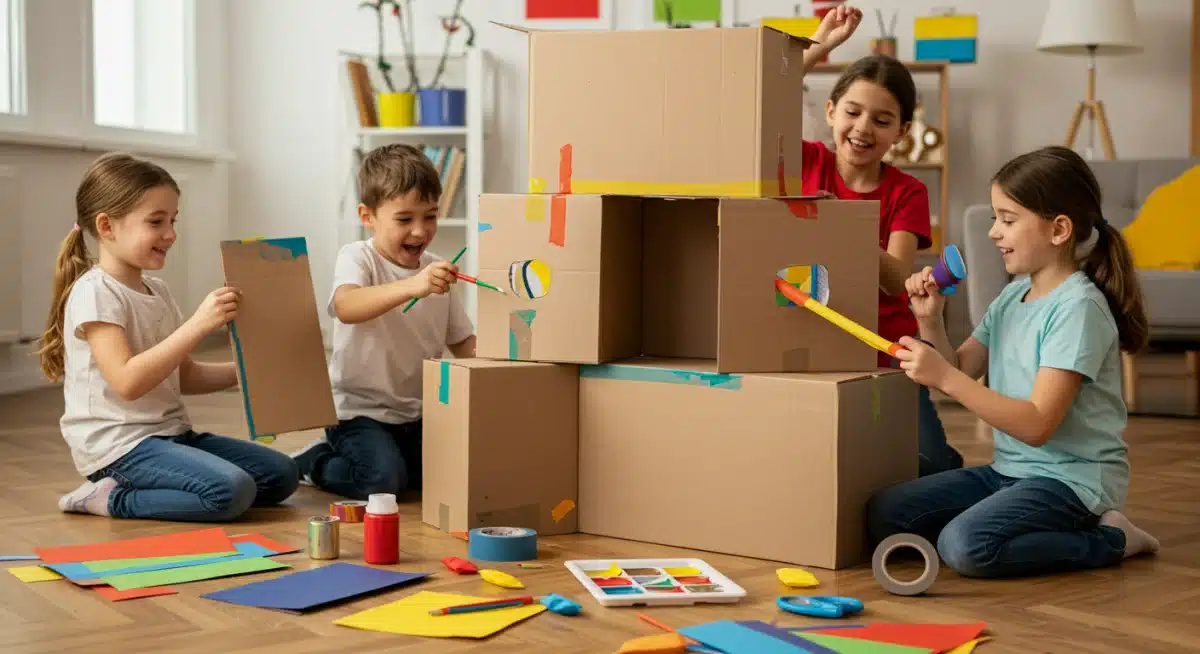
By providing a rich array of materials, you empower children to transform their ideas into tangible creations. The process of making something with their own hands instills a sense of accomplishment and boosts self-esteem, making DIY craft stations a powerful tool for creative development.
Storytelling Adventures: Imaginary Worlds from Everyday Items
Transforming your living room into a stage for storytelling adventures is an incredibly effective way to boost literacy, imagination, and communication skills. This doesn’t require elaborate costumes or props; often, the most engaging stories emerge from the simplest setups. Using everyday items as prompts can ignite incredible narratives, making children the directors and stars of their own tales.
Encourage children to pick a random object – a spoon, a sock, a toy car – and build a story around it. What’s its secret life? Where does it go when no one is looking? These questions serve as springboards for creativity. You can also introduce simple puppets made from paper bags or old socks, giving characters distinct voices and personalities. The beauty of storytelling is its boundless nature; there are no right or wrong answers, only endless possibilities.
Easy ways to ignite family storytelling sessions
- Story cubes: Roll dice with pictures to inspire plot points and characters.
- Chain stories: Each family member adds a sentence or two to continue the narrative.
- Shadow puppet theater: Use a flashlight and cut-out shapes to project stories onto a wall.
These interactive storytelling methods not only entertain but also enhance vocabulary, narrative structure, and confidence in public speaking. It’s a powerful and cost-effective way to foster a love for language and imaginative thinking within the family.
Kitchen Chemistry & Culinary Creations: Learning Through Taste and Experiment
The kitchen offers a fantastic, often overlooked, laboratory for learning and creativity. Engaging children in simple kitchen chemistry experiments or allowing them to participate in culinary creations can teach them about measurements, reactions, and healthy eating habits. Best of all, most ingredients are already in your pantry, keeping costs minimal.
Consider simple science experiments like making homemade playdough, baking soda volcanoes, or even growing crystals. These activities introduce basic scientific principles in a fun, tangible way. For culinary adventures, involve them in preparing simple snacks like fruit skewers, mini pizzas, or no-bake cookies. The act of following a recipe teaches sequencing and attention to detail, while the end result is a delicious reward.
Fun and educational kitchen activities under $20
- Homemade playdough: Flour, salt, water, oil, food coloring – endless sensory fun.
- Baking soda volcano: Baking soda, vinegar, dish soap, food coloring – a classic science experiment.
- Simple baking projects: Cookies or muffins from scratch, teaching fractions and measurement.
These kitchen-based activities provide hands-on learning experiences that are both educational and highly engaging. They teach practical life skills, foster independence, and create wonderful opportunities for family bonding over shared meals or scientific discoveries.
Building Challenges: Engineering Minds with Household Items
Building challenges are a fantastic way to develop spatial reasoning, problem-solving skills, and fine motor coordination. You don’t need expensive construction sets; many everyday household items can be transformed into incredible building materials. The goal is to encourage children to think like engineers, designing structures and solving challenges with the resources at hand.
Set a specific challenge, such as building the tallest tower, a bridge strong enough to hold a toy car, or a comfortable fort. Provide materials like cardboard boxes, paper towel rolls, plastic cups, toothpicks, marshmallows, or even blankets and pillows. The open-ended nature of these challenges allows for endless creativity and encourages children to experiment with different designs and materials. Collaboration is often key, making it a great team activity.
Creative building materials for under $20
- Cardboard boxes: From small cereal boxes to large moving boxes, perfect for forts and structures.
- Paper towel and toilet paper rolls: Excellent for connectors, columns, or tunnels.
- Plastic cups and straws: Ideal for creating intricate structures and testing balance.
These building challenges not only entertain but also lay the groundwork for understanding basic engineering principles, physics, and creative problem-solving. They teach resilience as children learn from failed attempts and refine their designs, ultimately leading to a sense of accomplishment when their creations stand tall.
Sensory Bins and Themed Play: Engaging All the Senses
Sensory bins are a wonderful tool for engaging young children, providing a rich tactile experience that stimulates development across multiple domains. They are surprisingly easy and inexpensive to create, often using items you already have around the house or can purchase for less than $20. Themed play enhances the experience, turning a simple bin into an entire world of exploration.
Start with a base material like rice, dry pasta, beans, or water beads. Then, add small toys, scoops, cups, and natural elements like leaves or small stones to encourage scooping, pouring, and imaginative play. You can theme your bins around seasons, holidays, or specific environments like a mini ocean or a construction site. This stimulates narrative play, fine motor skills, and sensory processing, all within a contained space.
Affordable sensory bin ideas for fall 2026
- Autumn harvest bin: Dried corn kernels, small gourds, plastic leaves, miniature farm animals.
- Forest exploration bin: Brown rice, pinecones, twigs, small plastic insects or woodland creatures.
- Pumpkin patch bin: Orange-dyed pasta, small plastic pumpkins, green pipe cleaners for vines, scoops.
Sensory bins offer a calming yet stimulating activity that can keep children focused and engaged. They promote independent play, encourage exploration of textures and colors, and provide a safe space for imaginative scenarios, making them an invaluable addition to your indoor creative play repertoire.
| Activity Type | Key Benefit |
|---|---|
| DIY Craft Stations | Fosters artistic expression and fine motor skills. |
| Storytelling Adventures | Boosts imagination, literacy, and communication. |
| Kitchen Chemistry | Teaches scientific principles and practical life skills. |
| Building Challenges | Develops spatial reasoning and problem-solving abilities. |
Frequently Asked Questions About Creative Play at Home
Creative play significantly enhances cognitive development, problem-solving skills, and fine motor coordination. It also fosters imagination, emotional expression, and social skills through collaborative activities, building a strong foundation for lifelong learning and personal growth.
Integrate learning subtly into fun activities. For example, use kitchen tasks to teach math (measurements) or science (reactions). Storytelling boosts literacy, while building challenges develop engineering concepts. Focus on hands-on exploration and discovery rather than rote memorization.
Offer a variety of options and let them choose. Sometimes, a child might prefer one type of creative play over another. Start with simple activities and participate alongside them to model engagement. Keep materials accessible and praise effort, not just the final product.
Many activities can be adapted for various ages. Younger children might focus on sensory exploration, while older ones can tackle more complex building or storytelling tasks. The key is open-ended materials that allow for different levels of engagement and creativity.
Utilize household items like cardboard, paper rolls, and old clothes. Shop at dollar stores or discount craft suppliers for basic materials. Repurpose and recycle whenever possible, and focus on the experience and interaction rather than expensive, specialized supplies.
Conclusion
Embracing creative play at home doesn’t require a large budget or elaborate setups. As we’ve explored, with a little imagination and resourcefulness, you can transform everyday items and spaces into vibrant learning environments. The 12 indoor family activities outlined here for Fall 2026 are not only cost-effective, each under $20, but also rich in educational value, fostering cognitive growth, fine motor skills, and robust family bonds. By prioritizing these engaging, hands-on experiences, parents can provide their children with invaluable opportunities for development and create lasting memories, proving that the most enriching play often stems from simplicity and shared creativity.